Beyond wordplay lies a profound truth. Scientists and Indigenous leaders alike remind us that all living things on this planet are interconnected — and that humans do not, and cannot, exist apart from the environment.
We are not separate from the world of animals and plants. We are profoundly and inextricably embedded in it: biologically, culturally, and linguistically.
“We are environment,” says Amazonian Indigenous leader Evaristo Nukuag.
Language bears witness to this fact. In English alone, we constantly draw on animal and plant imagery to express human behavior.
Sometimes with admiration — “lion-hearted,” “busy as a bee,” “happy as a lark.”
Other times with disdain — “chicken-livered,” “dumb as a dodo,” “monkey around.”
Each phrase is evidence of our deep — though often forgotten — kinship with nature.
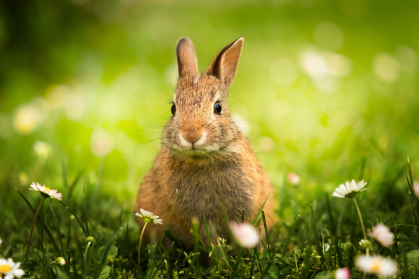
Following an idea down the rabbit hole…
The Joy of Word-Harvesting
Harvesting, sifting, and winnowing faunamorphs and floramorphs can be an immensely enjoyable endeavor for any wordshark — a kind of linguistic treasure hunt through woods and fields of meaning.
Each discovery feels alive: From the lion-hearted hero to the wallflower — the way we use nature in our language is a reminder of how we see reflections of ourselves in other living beings.
“Searching the forest of language is like foraging for metaphors — every clearing hides a new creature, every branch another bloom.”
Through these words, we learn not only about language but about human nature itself — how we naked apes (a faunamorph) describe, admire, and often misunderstand the animal kingdom and the plant world from which we stem and in which we are deeply rooted (two floramorphs).
Remembering what we are. Our language reveals who we are… and also who we believe we are.
True Nature
Accepting that we are animals — and part of nature’s continuum — is not an act of humility alone.
It’s a step toward healing our relationship with the planet.
When we embrace our true nature as fauna, we begin to dissolve the dangerous illusion of separation — that false divide between the so-called human world and animal world.
That false duality has fueled millennia of destruction:
the plundering of forests and oceans, the extinction of species, and the slow poisoning of the systems that sustain us.
To begin to heal, we must reclaim the truth our language has whispered all along: We are of the same breath and bone as the creatures we name.
Web of Life
Most of us scarcely realize how inextricably woven we are into the web of life.
Reversing ecological collapse requires more than technology or policy — it demands a transformation of perspective, a spiritual sea change in how we see ourselves in relation to the Earth.
Accepting that we are fauna opens the door to this transformation.
It reconnects us to empathy, to stewardship, and to peace with the living world
Without such a shift, our environmental crisis will remain unsolved at its root — for the root lies in how we think and speak about ourselves and others.
🐾 Tracks
Language as Evidence
Beginning with the premise that humans are fauna, this humble word-harvesting project offers linguistic proof that, on some deep level, we already know this truth.
No matter how fiercely we deny our animal nature, our words betray our understanding of it.
Through every floramorph and faunamorph, we reveal that our imagination — and our identity — are intertwined with all living things.
“Our metaphors are our mirrors.”
May this project not be mere wool gathering, but a way of remembering that language itself is alive — and that we, too, are part of the wild.
Collaboration & Partnership
Get in touch if you would like to partner with us on a project or initiative: